
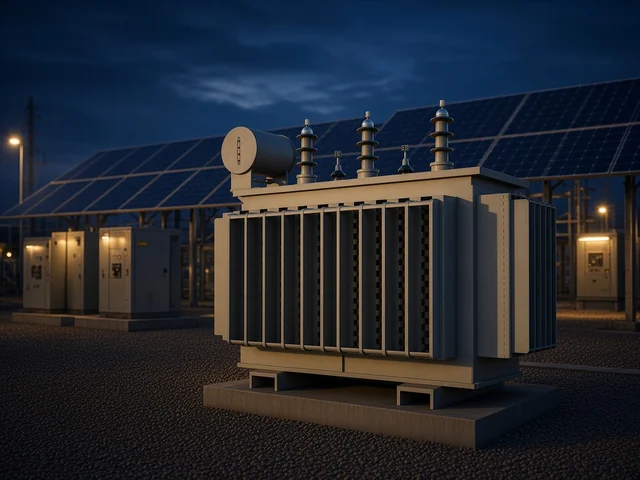
Overview
Solar and inverter duty transformers form part of a generating or power-conversion installation. The inverter equipment, transformer, collector system and grid requirements must be reviewed together. A plant’s generating capacity alone does not determine the transformer design, and this product category is not evidence of a particular utility’s approval.
Solar transformer specification: start at both interfaces
A useful solar/inverter-duty transformer enquiry includes the inverter maker’s electrical requirements and the network connection brief. Identify the requested apparent-power rating, voltages, operating profile, number and arrangement of interfaces, protection boundaries and any stated non-linear-load requirements. A solar plant’s headline MW figure is not, by itself, a completed transformer specification.
If the design calls for a step-up arrangement, give the actual input/output voltages and purchaser’s schedule. The expression “solar step-up transformer” does not establish standard ratios, winding count, vector group, earthing or guaranteed loss values. Those are technical-offer items.
Evaluate losses against the actual solar operating profile
Ask how no-load and load losses are stated and what reference conditions apply. Solar generation varies with the project’s operating pattern; a simple full-load-only comparison can miss the intended duty. Use measured or designer-supplied inputs rather than invented daily generation, tariffs or savings.
The EE Level 1/2/3 buyer guide explains loss-comparison questions, but distribution efficiency labels and BEE stars are not automatic certifications of a solar-duty design. Review renewable-energy buying questions, network power transformers and LT/control interfaces separately.
Typical applications and industries
The following are general duty contexts to discuss, not a list of OSTL customer installations or a guarantee of suitability for every site.
- Solar generation and inverter-linked renewable projects with an engineered network interface.
- Collector or step-up transformer duties where the project specification calls for them.
- Distributed generation installations requiring coordination between inverter and network designs.
- Renewable EPC and electrical-infrastructure projects preparing a transformer-specific technical schedule.
Define the operating duty
Supply the inverter data, single-line diagram, load/generation profile, required winding arrangement and network specifications. Have the engineer identify harmonic, earthing, protection, voltage-control and reverse-power requirements relevant to the actual scheme. Identify auxiliary transformer needs separately.
General construction considerations
These are design topics, not fixed features promised for every supplied unit. Confirm the construction in the project-specific offer.
- Core and windings selected against the agreed operating duty and loss requirements.
- Insulation, winding connections and earthing interfaces coordinated with the network design.
- Cooling, enclosure or tank, environmental exposure and terminal arrangement agreed for the site.
- Taps, monitoring and accessories specified where required; no fixed arrangement is assumed.
Ratings and scope
For these duty-specific products, ratings as per project requirement. The exact kVA/MVA, voltage, construction and operating limits require confirmation in the technical offer. OSTL’s overall power and distribution transformer range is up to 10 MVA and up to 66 kV; dry-type transformers are manufactured up to 3 MVA. These overall ceilings are not a confirmed rating schedule for every special-duty product, and 66 kV must not be applied to dry-type equipment.
BIS, ISO and project-specific documentation
OSTL has held BIS licences in all five major transformer categories since 2020. This is a company credential, not a blanket BIS certification claim for this product line. Ask for the exact licence scope and the standards and documentation applicable to the proposed equipment.
OSTL is ISO 9001:2015, ISO 14001:2015 and ISO 45001:2018 certified; copies available on request. Management-system certification does not establish a particular product rating, enclosure class, efficiency level or test approval. Agree the technical requirements and supporting records in the written offer.
Related equipment and project context
Send a clearer quotation brief
Contact the Kolkata corporate office with the equipment category, duty, rating required, supply/interface voltages, quantity, site conditions and requested dispatch destination. Unknown items can be marked for technical discussion; do not assume a standard configuration.
Landline: 033 4061 3200 · ostltd@hotmail.com. The quotation checklist can help organise the brief.
Losses, winding and cooling: compare the agreed design
For a special-duty transformer, define the actual operating profile and request guaranteed losses at stated conditions. An EE Level 1/2/3 distribution schedule or a BEE star label is not automatically applicable to furnace, rectifier or solar duty. ONAN, if requested for oil-immersed equipment, means oil-natural/air-natural cooling; confirm suitability and the proposed arrangement rather than assuming it is standard.
Copper and aluminium winding options are confirmed. Material selection belongs within the complete electrical and thermal design; neither material by itself guarantees a particular loss, service life or saving. For an oil-filled enquiry, any ONAN requirement must be confirmed in the technical offer; it is not a dry-type cooling label.
Compare offered no-load losses over energised hours and load losses against the actual loading profile at agreed reference conditions. Use the buyer’s tariff and operating inputs; no customer savings or payback is invented here. The EE Level 1 versus 2 versus 3 guide explains the buying questions, and routine-testing guidance helps define acceptance documents.
Manufactured in Howrah. Enquiries through Kolkata.
OSTL’s manufacturing units are Unit 1, Howrah, West Bengal and Unit 2, Sankrail, Howrah. The corporate office is in Kolkata. Send the exact destination, specification and purchaser’s documents; no regional factory, local stock or universal buyer approval is implied.
For eastern India, use the West Bengal, Odisha, Jharkhand and Bihar pages. The Assam/North-East hub provides the enquiry route for Guwahati and wider NE destinations. Nepal, Bhutan and Bangladesh enquiries need the destination and buyer’s documentary requirements; delivery responsibilities, eligibility and commercial feasibility are agreed for that enquiry.
Contact WhatsApp +91 70035 13107, landline 033 4061 3200 or ostltd@hotmail.com. Use the RFQ checklist or discuss repair and after-sales requirements. Online forms do not create a sent enquiry; use the listed contact channels.